
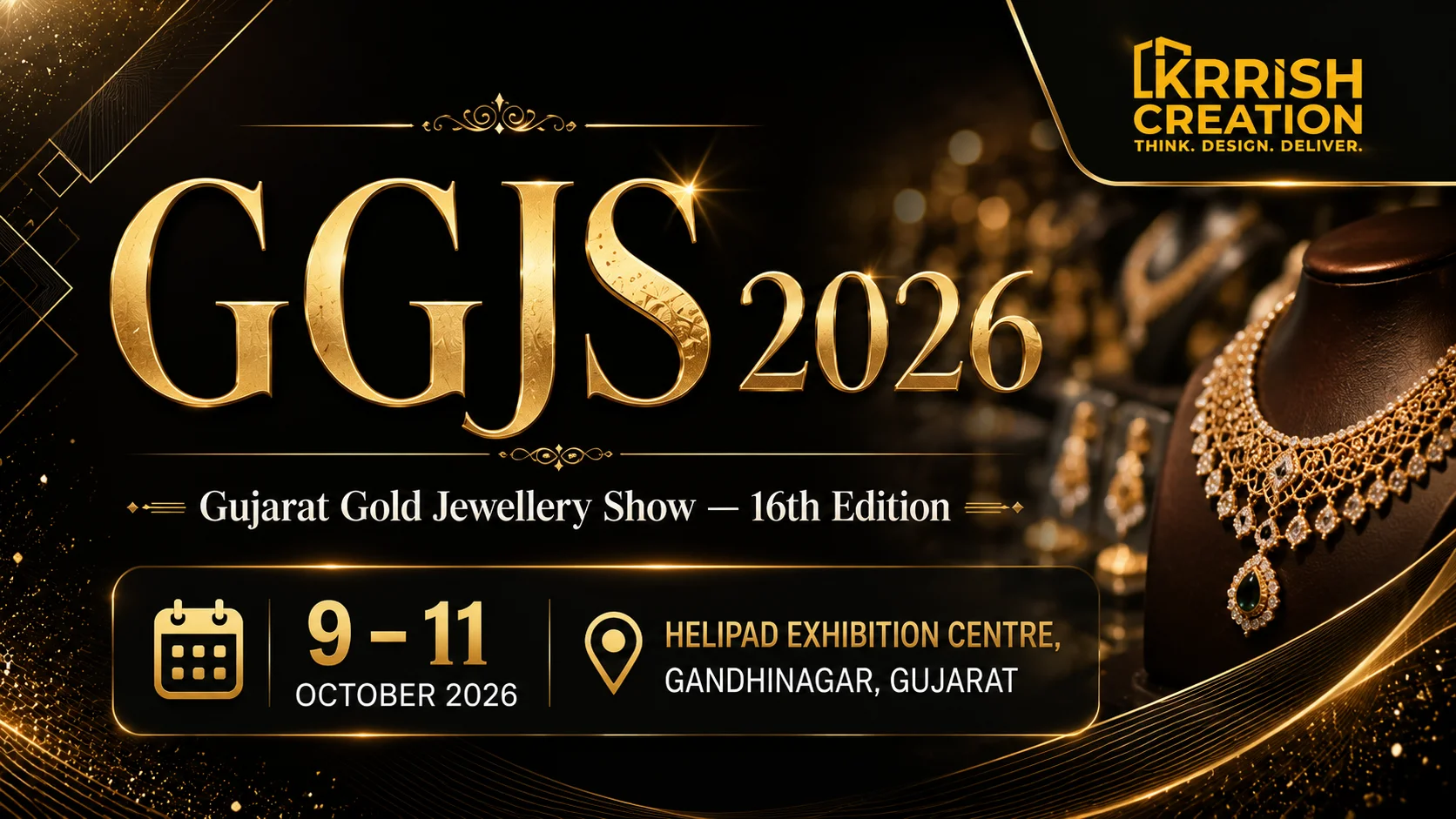
GGJS 2026 Exhibition Stall Design & Fabrication
GGJS 2026 is set to bring India's second largest B2B jewellery exhibition to Helipad Exhibition Centre, Gandhinagar — 600+ exhibitors, 1,000+ stalls, and three days where every square foot of your booth needs to earn its place. In jewellery, buyers judge credibility in seconds — lighting, security, and display quality speak before your team even says a word. Most exhibitors bring their best pieces and hope a rented shell scheme carries the rest, but a well-planned exhibition stall design is what actually earns attention on a show floor this size.
If you've exhibited at a jewellery show before, you know the real challenge: wholesalers comparing five stalls in ten minutes, gold and diamond pieces that need glare-free lighting to show true colour, and high-value inventory that needs to feel secure without looking guarded. In this guide, you will discover how to plan a jewellery stall built for GGJS's scale, what buyers actually respond to on a 1,000-stall show floor, and how to avoid the fabrication rush that hits exhibitors who book late — without juggling separate vendors for design, lighting, and security fittings.
Krrish Creation is a Gujarat-based exhibition stall fabrication company that has built stalls for jewellery, industrial, and consumer brands across India, Dubai, and international venues, with complete in-house design-to-installation capability.
What Is GGJS 2026 and Why Does It Matter for Exhibitors?
GGJS 2026, the 16th edition of the Gujarat Gold Jewellery Show, runs 9–11 October 2026 at Helipad Exhibition Centre, Gandhinagar, Gujarat. It is jointly organised by the Gold Ornaments Wholesale Jewellers Association (GOWJA) and GGJS Events Pvt. Ltd., and is recognised as India's second largest B2B jewellery exhibition, with the 2026 edition expected to bring 600+ exhibitors across 1,000+ stalls.
GGJS is India's second largest B2B jewellery exhibition, connecting gold, diamond, silver, and gemstone manufacturers and wholesalers with retailers, distributors, and traders from across India. It works by bringing the full jewellery value chain — plain gold, studded, diamond, Kundan, antique, branded, and lab-grown categories — together with wholesale buyers on one show floor. It's most commonly used by manufacturers and wholesalers to secure new distribution and retail partnerships across the West India market in a single event. See our list of upcoming trade shows for other Gujarat events worth planning around.
Who Exhibits at GGJS?
Gold jewellery manufacturers, diamond and studded jewellery brands, Kundan and antique jewellery makers, silver and 925 sterling jewellery companies, gemstone and pearl suppliers, and jewellery machinery, packaging, and software providers typically exhibit.
Who Visits GGJS?
Jewellery wholesalers, retailers, manufacturers, importers, exporters, traders, diamond and gemstone dealers, and pearl suppliers make up the core visitor base, drawing footfall from across India.
Why Does Exhibition Stall Design & Fabrication Determine Your ROI at GGJS?
At GGJS 2024, the show drew over 20,000 visitors across three days, with 800 B2B stalls spread over 276,000 square feet (Heera Zhaveraat, 2024). With the 2026 edition scaling further to 1,000+ stalls, a stall that relies on a basic shell scheme and a few glass counters simply won't hold attention against 600+ competitors.
Exhibition stall design and fabrication is the combined process of planning a booth's layout, security, and lighting, then physically constructing it to display high-value products and support buyer conversations. It works by pairing structural fabrication with jewellery-specific display engineering — anti-glare lighting, lockable showcases, and clear category zoning placed where wholesale buyers look first. It's most commonly used at large B2B jewellery shows like GGJS, where product quality is judged by how it's lit and displayed, not just what it is.
A professionally planned exhibition stall design isn't decoration — at a show this size, it's the difference between a wholesaler stopping to examine your diamond range or walking straight past to a competitor with better-lit showcases.
What Should a High-Performing GGJS 2026 Stall Include?
Jewellery is a trust-and-detail business — buyers need to see true colour, feel secure that inventory is protected, and move through your product categories without confusion, all within a short window on the show floor.
• Lockable glass showcases — secure display for gold, diamond, silver, and gemstone jewellery that protects inventory without slowing down service
• Anti-glare, jewellery-specific lighting — LED lighting engineered to show true metal and stone colour without harsh reflections
• Clear category zoning — organised sections for plain gold, studded, diamond, Kundan, antique, and branded jewellery so wholesalers navigate quickly
• Private discussion zones — enclosed space for serious buyer negotiations and bulk order discussions
• Premium display counters with clean product zoning — organised presentation that makes browsing easier for wholesale and retail buyers
• Brand walls and reception counters — clear visual identity and organised visitor handling on a 1,000-stall show floor
• Integrated lead capture — structured enquiry points to capture qualified wholesale and retail leads across all three days
How Does Exhibition Stand Fabrication Work for Jewellery Exhibitors?
Jewellery fabrication carries different priorities than a standard industrial booth — security fittings, precision lighting placement, and finish quality all need to be right, because buyers are evaluating your brand credibility through the stall itself.
Exhibition stand fabrication is the construction process that turns a stall design into a physical structure, including lockable showcases, lighting rigs, and finished counters, built before the venue's deadline. It works by combining structural carpentry with jewellery-specific finishing — glasswork, lighting calibration, and secure cabinetry — completed before the show opens. It's most commonly outsourced to specialist exhibition stand fabrication companies rather than handled in-house, since lighting and security work require specific expertise most jewellery brands don't have internally.
At Helipad Exhibition Centre, October follows a packed September exhibition calendar, so fabrication capacity for GGJS should be booked well ahead to avoid rush pricing and material shortages. Our exhibition stall fabrication team schedules well in advance to protect your build slot during this busy season.
Should You Book a Local Gandhinagar Stall Fabrication Team, or Bring Your Own?
With exhibitors travelling in from across India for GGJS, many assume they can manage stall setup remotely or ship pre-built fixtures. In practice, this creates risk exactly during the tight build-up window before a 1,000-stall show opens.
A local exhibition stall fabrication team is a Gujarat-based contractor who manages design, secure fittings, and on-site installation without shipping delays. It works by handling everything within driving distance of the venue, cutting the logistics risk that outstation vendors carry for delicate glasswork and lighting. It's most commonly the safer choice for jewellery exhibitors who cannot personally supervise installation of secure display fixtures from another city.
As a full-service trade show booth contractor, Krrish Creation manages design, fabrication, Gandhinagar logistics, on-site installation, and post-event dismantling as one coordinated project — so you're not juggling separate vendors for stall build, lighting, and security fittings.
Custom vs Modular Exhibition Stalls: Which One Fits GGJS 2026?
Not every jewellery exhibitor needs a fully custom build every year. If you're returning to multiple Gujarat trade shows — GGJS, Aluminium Bharat, Agri Asia — a modular system with jewellery-grade fittings is often the smarter investment.
A modular exhibition stall uses pre-engineered, reusable structural components — including reusable showcase frames — that reconfigure for different booth sizes across multiple events. It works by standardising panels, lighting rigs, and secure cabinetry that can be resized rather than rebuilt from scratch each time. It's most commonly chosen by jewellery brands exhibiting at three or more shows a year to reduce per-event fabrication costs significantly.
Our exhibition stall fabrication team builds modular systems that reconfigure across different floor dimensions, so the same investment works for GGJS this October and your next jewellery show right after.
Quick Decision Guide
• Choose custom if this is a flagship collection launch or you have a large corner/island plot
• Choose modular if you exhibit at 3+ shows annually and want cost efficiency without sacrificing brand consistency
Trust & Industry Insight
GGJS 2026 marks the show's 16th edition, delivering what organisers describe as "an even larger and more dynamic experience for exhibitors and trade visitors alike" (GGJS, 2026), with the 2025 edition already having drawn 500+ exhibitors and 1,000+ stalls across 2.8 lakh sq. ft. That scale means competition for wholesale buyer attention keeps intensifying with every edition.
In our own project experience across Gujarat trade shows, exhibitors who lock in their exhibition stall design and fabrication plan at least 6–8 weeks before the show consistently get better fabrication slots, properly calibrated lighting, and zero last-minute compromises — compared to those who start planning 2–3 weeks out and end up settling for generic shell-scheme lighting that dulls their product. See examples in our exhibition stall portfolio.
Conclusion
GGJS 2026 gives gold, diamond, and silver jewellery brands direct access to one of India's largest concentrated wholesale buyer bases — but only if your stall is built to show your products at their best among 600+ competitors. Prioritise anti-glare lighting, secure showcases, and clear category zoning, and lock in your exhibition stall design and exhibition stand fabrication partner early, since October follows Gujarat's busiest exhibition season. Whether you need a fully custom build or a modular system for repeat shows, the right trade show booth contractor turns your booth into your strongest sales tool on the floor.
Ready to plan your GGJS 2026 stall? Get a free quote from Krrish Creation and see our full exhibition stall portfolio before you book.
Frequently Asked Questions — GGJS 2026 Exhibition Stall Design & Fabrication
When and where is GGJS 2026?
GGJS 2026, the 16th edition of the Gujarat Gold Jewellery Show, runs October 9–11, 2026 at Helipad Exhibition Centre, Gandhinagar, Gujarat.
Who organises GGJS 2026?
GGJS 2026 is jointly organised by the Gold Ornaments Wholesale Jewellers Association (GOWJA) and GGJS Events Pvt. Ltd.
How big is GGJS 2026?
GGJS is India's second largest B2B jewellery exhibition, with the 2026 edition expected to feature 600+ exhibitors across 1,000+ stalls, following the 2025 edition's 500+ exhibitors and 2.8 lakh sq. ft. of exhibition space.
How much does exhibition stall design and fabrication cost for GGJS 2026?
Jewellery stall costs typically run higher per square foot than standard exhibition stalls due to secure showcases and specialised lighting. Contact Krrish Creation with your stall size for an accurate, free quote.
How early should I book my stall design and fabrication for GGJS?
Start 6 to 8 weeks before the October 9 opening. October follows a packed September exhibition season at Helipad Exhibition Centre, so early booking secures better fabrication slots.
Can Krrish Creation handle both design and on-site installation?
Yes. Krrish Creation manages the complete project — 3D design, in-house fabrication, secure showcase fittings, Gandhinagar logistics, on-site installation, and post-event dismantling — as a single, coordinated service.
What stall design works best for jewellery brands at GGJS?
A layout with lockable glass showcases, anti-glare jewellery lighting, clear category zoning, private discussion zones, and integrated lead capture consistently performs best on a 1,000-stall show floor.
Should I choose a custom or modular stall for GGJS 2026?
Choose custom for a flagship collection launch or large plot; choose modular if you exhibit at multiple Gujarat trade shows annually and want to reduce repeat fabrication costs.
Why is lighting so important for a jewellery exhibition stall?
Anti-glare, colour-accurate lighting shows the true brilliance of gold, diamonds, and gemstones. Poor lighting can make even high-quality jewellery look dull, directly affecting how wholesale buyers judge product value on the show floor.

